
In 2011 I did a 4 week project to gain a much muscle as I could without using any drugs. I gained 5 kilos by following three simple principles:
- I recorded my protein intake each day.
- I did no more than 5 exercises per workout.
- I used a variable training frequency.
Recording Protein Consumption
In 2008 I tried to gain muscle by doing all the things that fitness magazines say you should. I ate lots of protein, plenty of vegetables and whole grains; I worked 3-4 times a week (focusing on major muscle groups); I got plenty of sleep…and nothing happened.
I gained 840 grams of muscle over the course of a month. I started at 64.2 kilos and ended up at 65.2 kilos while my body fat stayed at 16.17% (I had the same personal trained administer a 4 point skin caliper assessment both times).
Given that I was working out for 3-4 hours a week and dedicating myself to eating healthy…I expected to more than a mere kilo of muscle.
My workouts were split into 3 upper body and 3 lower body exercises with a core exercise on each workout. I didn’t know how exactly much protein I consumed on a day-to-day basis but I was eating lots. I was supplementing with a protein shake, I had eggs for breakfast and at least some form of meat through the day.
I now know that eating “more” protein and working out “hard” means nothing when you don’t know how much protein you need or how hard you need to work.
The fact of the matter is that you need between 1.25g and 2.5g of protein per kilo of lean body weight if you want to grow muscle.
To work out your lean body weight you will have to know your exact body fat percentage. One way to do this is to go to your local gym and ask one of the personal trainers to administer a skin fold test (if you do this then make sure the same personal trainer tests you every time you get measured and make sure he uses the same algorithm each time). You can also do your own skin fold test but it will probably be less accurate. Another approach is use a bio-electrical impedance tool (Google it). If you go for this option then make sure you are consistently hydrated every time you do a test. This mean drinking 1.5 litres of water immediately upon waking on test day, waiting for 30 minutes and then urinate before you take the test. The result may not be accurate but it will always be consistently inaccurate which mean you can effectively track your progress.
When I started the second growth program I weighed in at 70 kilos with a body fat percentage of 11.3 %. This meant I had 7.94 fat and 62.06 kilos of lean mass.
- 62.06 x 1.25 = 77.5g
- 62.06 x 2.5 = 155g
It turns out I had to eat between 80 and 150 grams of protein on a daily basis.
Eating an extra ham sandwich and drinking a protein shake is not going to cut it.
Consuming that quantity of protein on a daily basis turned out to be a lot more expensive than the magazines tell you and it requires some serious commitment to meal planning.
The second time around I was drinking a protein shake as soon as I woke and one just before bed. I ate 3 meals a day with at least 20 grams of protein and a portion of whole grains at each meal. I also drank at least 1 liter of milk a day.
The final results were:
- 6th March > 3rd April
- Weight 70kg > 75.1kg
- Fat % 11.34 > 13.42
- Lean Mass 62.06kg > 65.02kg
- Fat Mass 7.94kg > 10.08kg
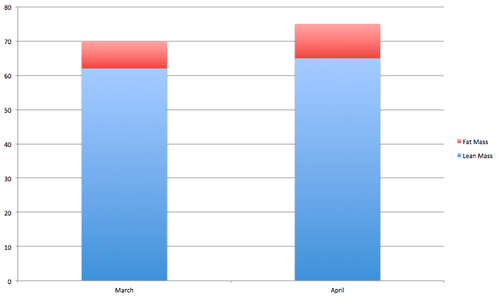
My measurements were as follows:
- Neck 38-40 cm Shoulders
- 114-117 cm Chest
- 97-99 cm Waist
- 80-88.5 cm
- Hip 94-99 cm
- Thigh 54-59 cm
I went completely overboard and consumed upward of 350 grams of protein on some days. That’s more than double the necessary amount for maximal growth. I wanted to see if feeding yourself more protein led to more growth. It didn’t, It just turned to fat.
I recommend starting at the lower end of the range and measuring your progress each week. If you are not growing then add more protein to your diet. If you hit the upper end of the range and you are still not growing then add more calories to your diet.
Five Exercises Per Workout
When I first tried to gain muscle I did as much exercise as I could, trained to failure and trained as frequently as I could.
In 2008 I worked out 3-4 days a week. I was doing 4 exercises per workout, 5 sets of 15 reps each (This was split an upper body routine and a lower body routine with a core exercise on both days):
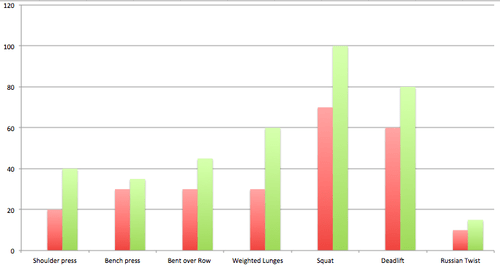
The weights were getting heavier but I wasn’t growing.
In 2011 I changed things around and instead I trained with as much weight as I could for one super slow set to failure.
I split my program into three section: Pushing muscles, pulling muscles and leg muscles.
This is how I progressed on each exercise:
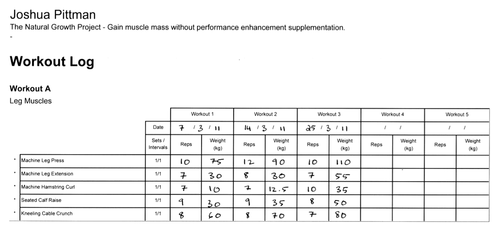


Doing multiple sets and exhausting yourself in the gym is great for developing endurance but it isn’t very useful when you are trying to grow muscle. Growing muscle requires you to train with a weight heavy enough that you fail between 8-12 repetition and you can slow it down to 10 second a repetition to completely eliminate momentum.
I did this experiment to prove to myself that it was possible to gain muscle doing very small amounts of extremely specific exercise. If I were to repeat the program I would probably to more exercise to make the program more interesting. If you don’t want to do add exercises then I certainly recommend adding an full body stretching routine to the schedule on the off days. Training to failure on a regular basis made my body stiff. I would also add a cardio element to the program as I felt very unfit doing so little exercise and eating so much food.
Variable Training Frequency
I believe that the key to my success the second time round was giving my body enough time to recover from the workouts and then giving it even more time to get stronger before I worked out again.
As I was lifting significantly heavier loads on each successive workout, I needed more to time to recover and thus the time between workouts got longer and longer between as I progressed.
Knowing when to workout involved listening to my body. If my muscles were still sore, if I felt tired or not motivated to how workout in the slightest then I waited. When I felt ready for my next workout I then wait at least an extra day before I went back to the gym. This gave my body time to get stronger after it had fully recovered. If I did not lift more that I did the previous time on any given exercise then I did not wait long enough.
This is how my workouts were spaced over the course of the month.

Conclusion
If you have struggled gaining muscle at a gym these tweaks may help you get better results (avoid the mistakes I made).
A lot of people think that growing muscle is a narcissistic waste of time. All I can say is that my natural growth experiment completely changed what I think I am capable of doing, not just with my body, but just personally.
Whether you like it or not, exercise is a necessary part of life. If you let it consume you it will become a narcissistic endeavour. On the other hand, if you experiment with it, ask questions and test assumptions then you can learn lessons that transfer to other aspects of your life.
 Josh Pitzalis